866-972-5373
 Account Login


 866-972-5373
 Account Login


The best pre-employment assessment for sales depends on the role you are hiring for and the information needed to help you make your hiring decision. For learning and reasoning, consider the Criteria Cognitive Aptitude Test (CCAT). For workplace personality, look at the Hogan Personality Inventory. For existing sales skills, consider TestGorilla’s B2B Sales Lead Generation test. For new-business motivation, evaluate The DriveTest®. And for behavioral alignment with a defined job, consider The Predictive Index Behavioral Assessment alongside its Job Assessment.
These five tools answer different questions, and none can provide a complete sales hiring decision by itself.
I’ve spent more than 20 years studying why some sales candidates become strong producers while others disappoint. One lesson keeps coming back: a candidate’s ability to sell themselves in an interview is not the same as their ability to generate revenue.
“You’re not hiring a salesperson because you need someone who interviews well. You’re hiring that person to generate revenue.”
The question to ask before buying any assessment is simple: What important uncertainty about this sales candidate is my existing hiring process failing to resolve?
So let’s review five pre-employment test options in this category-based buyer’s guide to assessments.
Five Types of Sales Pre-Employment Assessments Compared
| Assessment category | Recommended example | Most useful hiring question | What it cannot establish alone |
|---|---|---|---|
| Cognitive ability | Criteria CCAT | Can this person learn quickly, reason and solve problems? | Whether they will pursue new business consistently |
| Workplace personality | Hogan Personality Inventory (HPI) | How is this person likely to approach work and relationships? | Demonstrated selling skills or quota attainment |
| Sales skills and knowledge | TestGorilla B2B Sales Lead Generation | Does the candidate understand prospecting and lead generation? | Sustained willingness to prospect after rejection |
| Sales motivation | The DriveTest® | Does the candidate show the Drive relevant to hunter sales? | Technical knowledge or sales execution |
| Behavioral role fit | Predictive Index Behavioral Assessment + Job Assessment | How do the person’s tendencies compare with actual job demands? | Success if the job requirements are poorly defined |
Note: the recommendations above are best-fit examples by category, based on each tool’s stated purpose and published information, not an independent comparative performance study.
Why Communication-Style Development Tools Are Not on This List
Communication-style assessments can help you understand how your sales reps interact with prospects, colleagues and managers. However, most communication tools are not designed or validated for employment selection.
Before using one to screen applicants, verify that it supports hiring decisions and can provide appropriate job-related validation evidence. A coaching tool should not be presented as a pre-employment hiring test.
1. Best for Cognitive Ability: Criteria Cognitive Aptitude Test (CCAT)
The Criteria Cognitive Aptitude Test (CCAT) evaluates learning ability, critical thinking and problem-solving. It uses a 15-minute, 50-question format covering areas such as verbal, numerical and spatial reasoning.
When I would consider it: A technical account executive needs to learn complicated software, interpret customer information and translate product details into business decisions. Reasoning ability is directly relevant to those demands.
What I would not infer: A high cognitive score does not tell me whether the candidate will make another cold call after ten unanswered attempts. Ability and willingness are separate questions. Nor should a low score be interpreted without understanding the actual cognitive demands of the job.
Ask before buying: How did you establish an appropriate score interpretation for our sales role, and what accommodations are available?
2. Best for Broad Workplace Personality: Hogan Personality Inventory
The Hogan Personality Inventory (HPI) is a workplace personality assessment based on the five-factor model. Its scales cover characteristics including ambition, sociability, prudence and adjustment. Hogan describes a typical completion time of 15–20 minutes.
When I would consider it: An organization needs a broader understanding of a salesperson’s workplace tendencies, perhaps because the role involves autonomy, internal coordination and complex stakeholder relationships.
What I would not infer: A personality label is not a sales forecast. For example, a sociable candidate may build rapport easily but still fail to initiate prospecting. A quieter candidate may ask excellent discovery questions and outperform a charismatic peer.
Evaluate the pattern of job-relevant behavior, not whether the profile resembles the most likeable salesperson.
Ask before buying: Which reported characteristics have evidence of relevance to this role, and how will the results change the interview?
3. Best for Checking Sales Skills: TestGorilla B2B Sales Lead Generation
TestGorilla’s sales assessment library includes a B2B Sales Lead Generation test designed to evaluate knowledge and experience in prospecting and generating qualified opportunities. TestGorilla lists it as a 10-minute, multiple-choice test. Its catalog also offers other sales-role tests, so the exact module matters.
When I would consider it: A business is hiring an SDR or BDR who claims to know lead qualification, prospecting methods and outbound fundamentals. A focused knowledge test can distinguish a candidate who understands the process from someone who only knows the terminology.
What I would not infer: Selecting the right answer to a prospecting scenario is different from consistently performing the work. A person can know that follow-up matters and still avoid it when the day becomes uncomfortable. A knowledge test also differs from a live cold-call simulation.
Ask before buying: Is this test measuring knowledge, judgment or demonstrated behavior? What additional work sample(s) would verify real execution?
4. Best for Hunter Sales Motivation: The DriveTest® by SalesDrive
For salespeople responsible for creating new business, I believe motivation deserves its own category. After studying more than 80 years of research on the personality traits shared amongst top-performing salespeople, I found that three non-teachable characteristics were observed over and over again in successful salespeople: Need for Achievement, Competitiveness and Optimism. Collectively, at SalesDrive, we refer to these three traits as Drive.
These are the characteristics our DriveTest® assessment was designed to examine in sales candidates. The assessment also measures Confidence, Persuasiveness, Relationship Skills and Organization. It takes approximately 20 minutes and consists of 42-forced choice questions. The report provides a response-consistency indicator and interview questions to investigate important findings.
When I would consider it: A hunter, SDR, BDR or outbound account executive must generate opportunities without a steady supply of inbound leads. The question is not merely whether the candidate knows how to prospect, but whether they are likely to sustain effort, competition and resilience under rejection.
What I would not infer: A high-Drive profile does not prove that someone can run discovery, sell your product or succeed in a particular territory. I helped create this assessment, and I would still insist on using a behavioral interview, references and a relevant work sample. It is especially relevant to hunter roles; it is not automatically the right first test for a primarily service-oriented position.
Ask before buying: Does this role require independent pipeline creation, and can the report help me investigate that requirement?
5. Best for Behavioral Role Alignment: The Predictive Index
The Predictive Index Behavioral Assessment examines workplace drives related to Dominance, Extraversion, Patience and Formality.
The PI Job Assessment is a separate process for defining what a job requires and creating a Job Target against which candidate results can be considered.
When I would consider it: A company has several distinct revenue roles and keeps moving successful account managers into pure prospecting positions—or moving strong hunters into account-maintenance work—without recognizing the difference in daily demands.
What I would not infer: A candidate who matches a poorly constructed Job Target is not necessarily a good hire. The Job Assessment does not measure the candidate; it establishes the team’s expectations for the role. If those expectations are vague, contradictory or based on the previous incumbent’s personality, the comparison can create false confidence.
Ask before buying: Did the people defining this job agree on how the salesperson will generate revenue, or did they simply agree on an attractive personality profile?
Overlooked Hiring Question: Where Did the Candidate’s Revenue Come From?
Imagine two sales candidates who both report $1 million in annual sales. One inherited long-standing accounts and received qualified inbound leads. The other opened a new territory and built most of the pipeline independently.
Those numbers may be identical, but the work behind them was not.
Before selecting a pre-employment assessment for sales, define the source of revenue in the job you are filling.
- How much pipeline must the person create?
- How much comes from established accounts?
- How sophisticated is the product?
- How much support does the company supply?
For an outbound SDR, I would emphasize motivation, prospecting knowledge and realistic outreach exercises. For a technical seller, I would add learning ability and a problem-solving exercise. For an account manager, relationship management, organization and expansion skills may deserve greater attention.
Your test mix should follow the actual assignment, not the sales title.
4 Questions to Use When Comparing Sales Hiring Assessments
1. Does the validation match the decision you need to make?
Ask the vendor to show what the assessment predicts, which jobs were studied and how success was measured. Supervisor ratings, revenue and retention answer different questions. Ask whether researchers studied current employees or followed applicants after hiring. Both may be informative, but they are not interchangeable. Our guide to sales assessment validity explains these distinctions in more depth.
2. Can your managers use the report?
Request a sample before a demonstration. Ask a sales manager to identify two strengths, two uncertainties and the interview questions they would ask next. If the report produces labels without a clear investigation plan, your team may not get much practical value from it.
3. How does the assessment address impression management?
Sales candidates often know how to make a compelling impression. Ask how the test was designed to protect against candidates showing themselves in an overly favorable way. The DriveTest uses a forced-choice format and a consistency scale; Criteria describes validity scales in SalesAP. Neither should be interpreted as making every response unquestionable. Investigate unusual results and corroborate important findings.
4. What is the experience like for candidates?
Count the entire assignment, including added tests, custom questions and work samples. A short individual test can become a lengthy battery. Explain why the assessment is relevant, how long the full process takes and where candidates can get assistance. Ask vendors about accessibility and accommodation procedures before rollout. Unnecessary testing can drive away people you would like to hire.
When Should You Give Sales Candidates an Assessment?
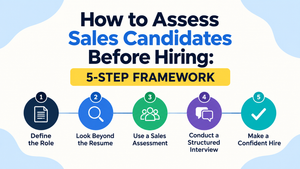
My preferred sequence is to screen for basic qualifications first, assess next and conduct the deeper behavioral interview after reviewing the assessment findings.
This lets you use the data while you still have time to investigate it.
- Define what success looks like in your role.
- Review applications and complete a brief initial screening.
- Administer a job-relevant assessment with an appropriate candidate experience.
- Use the assessment results to guide behavioral questions and a short sales work sample.
- Verify key claims with references, consider all evidence together and make your decision.
An assessment should never become an automatic pass/fail decision. Use a consistent, job-related process for all candidates for the same position.
What Does Your Next Sales Hire Actually Require?
The strongest hiring process does not use the most assessments. It identifies the most consequential uncertainties and gathers credible evidence about each one.
- If your next hire needs to master a complex offering, consider cognitive ability.
- If you need evidence about current sales knowledge, use a focused skills assessment.
- If the role requires self-generated pipeline, examine motivational characteristics associated with sustained new-business effort.
- For behavioral role alignment, compare the candidate with a carefully defined job.
Communication-style development tools may be valuable after hiring but should not be substituted for validated pre-employment assessments.
For a broader vendor comparison, see our guide to the best sales assessment tools. It covers providers by specialization.
If you’re comparing pre-employment assessments for your sales team, download our Sales Hiring Assessment Comparison Guide for a side-by-side look at different assessment options, their strengths, and which may be best suited to your hiring needs.
Frequently Asked Questions
There is no universally best instrument. The most appropriate choice depends on whether you need evidence about learning ability, workplace personality, demonstrated sales skills, hunter motivation or behavioral role fit.
Select the category based on the work, then assess the provider’s relevant validity evidence and reporting.
No. A personality test describes relatively stable tendencies; a skills test evaluates knowledge or capability at a particular task. Neither score should automatically be treated as proof of sustained sales production. They answer different hiring questions.
Only when each additional measure addresses a different, important uncertainty.
A technical hunter role may justify both reasoning and motivation evidence, followed by a live discovery exercise. Adding overlapping tests simply because a platform offers them wastes candidate and manager time.
A well-supported assessment may help forecast some job-relevant outcomes, but it cannot guarantee quota attainment. Territory quality, management, product-market fit, pricing, onboarding and the sales process also influence results.
Treat test results as evidence to combine with interviews and verified experience.
About the Author: Dr. Chris Croner is a clinical psychologist and Principal at SalesDrive, LLC. He developed The DriveTest® sales assessment and is co-author of Never Hire a Bad Salesperson Again. He has helped more than 1,500 companies worldwide identify and hire top-performing salespeople. Connect with him on LinkedIn.